Worker ingress protection inspects public requests before they reach Access or application code. One policy covers the Worker’s platform URL and all active custom domains. Deploying a new application version does not replace this policy.
This capability is currently a preview on the local single-node and reference Latitude profiles, with every Worker initially Off. Enabling the service on an installation does not begin filtering existing Workers; an organization must choose Observe or Enforce for each Worker.
Start with observation
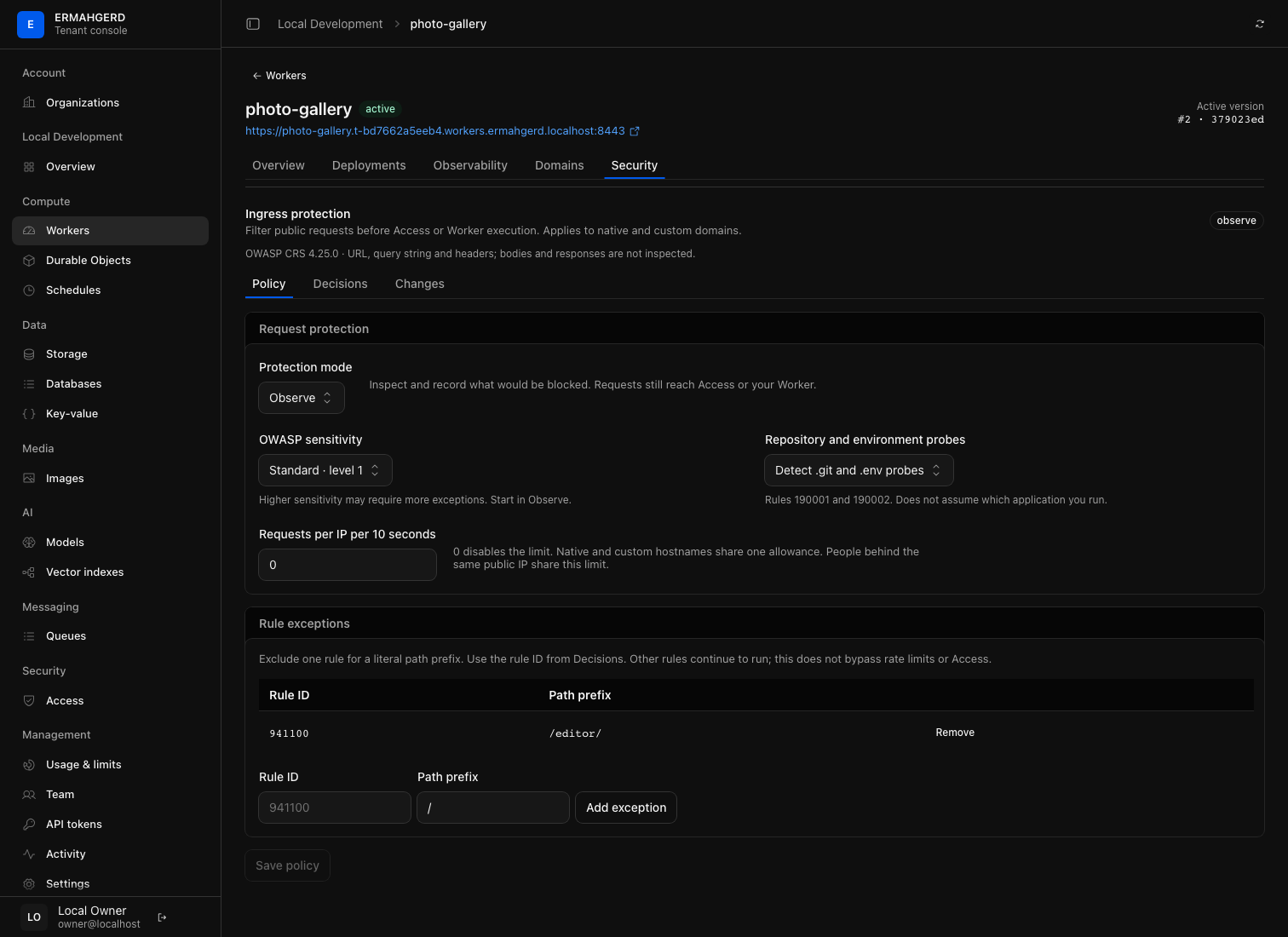
Open Workers → your Worker → Security → Policy. Choose Observe, save, then exercise your normal application workflows. The page confirms publication only after both the inspection profiles and the new HAProxy generation are ready. If activation cannot be confirmed, the desired policy remains saved and the page offers Retry publication.
| Mode | Behavior |
|---|---|
| Off | No WAF inspection or configured rate limiting. |
| Observe | Evaluate requests and record matches and rate-limit decisions; do not block. Inspection failures also pass through and are recorded. |
| Enforce | Block matched requests with 403, rate-limited requests with 429, and requests whose inspection could not complete with 503. |
Decisions shows recent matches and inspection errors. Its time window and pagination are part of the URL. Changes records policy revisions, the actor, and configuration automatically; no free-form reason is required.
Tune a rule without bypassing protection
The managed profile uses OWASP CRS 4.25.0 through Coraza 3.7.0 and its 0.9.0
HAProxy agent. Standard sensitivity is paranoia level 1; Strict is level 2.
Optional repository/environment rules identify .git and .env probes.
Add an exception using the matching rule ID and a literal path prefix.
For example, CRS rule 920420 applies a web-form-oriented content-type allowlist.
A Worker accepting raw JPEG uploads may need an exception for that rule at
/upload. CRS rule 911100 restricts HTTP methods; API endpoints accepting PUT
or PATCH may need a scoped exception as well.
Other rules continue to run. A request may match several independent rules:
excluding the .env probe rule does not also exclude CRS’s restricted-file rule.
Review the remaining decisions instead of disabling the final anomaly-score
blocking rule. Engine/evaluation rules cannot be added as tenant exceptions.
Prefixes are literal, case-sensitive request paths, not regular expressions.
/editor/ is narrower than /, which covers the entire Worker. Exceptions never
bypass Access or rate limits. Each policy supports up to 20 exceptions.
Understand what is inspected
The preview inspects the URL, query string, and request headers. Request bodies and responses are not inspected. Upload bodies are not buffered for inspection, and streaming responses remain streaming. This is not malware scanning and does not validate uploaded content or replace application authorization.
Decisions retain a request ID, hostname, path, action, and matching rule IDs. Query values, bodies, cookies, authorization headers, and matched payloads are not included. Paths themselves can contain application-sensitive identifiers; avoid putting secrets in URLs.
Requests blocked at ingress do not invoke or meter a Worker. Observe requests that reach the runtime are metered normally. Security denials are separated from application request metrics and logs. Internal service-binding and background event delivery do not pass through this public HTTP policy.
Rate limits and operating boundaries
Rate limits use the actual incoming source IP, not a client-supplied forwarding header. Native and custom hostnames share the same per-Worker allowance. Users behind a common NAT share a limit; set it with that in mind. A value of 0 disables rate limiting. Counters are local, short-lived traffic controls, not durable quotas; proxy reloads may reset them.
The inspector runs beside HAProxy with a bounded CPU and memory budget. Identical policies share compiled rule profiles. Up to 32 distinct active or draining profiles can be resident; previous profiles remain available while old ingress generations drain. This is a capacity guard, not a billable organization quota.
For self-hosted evaluation, install Go on the Ansible controller, set
waf_enabled: true for the ingress host, and provision it. The local demo supports:
make waf-site
make waf-check
The check deploys a temporary Worker through Wrangler, exercises all modes,
exceptions, large streamed bodies, inspection failures, and steady 10 RPS, then
removes that Worker. Results are retained under artifacts/waf/.
The local WAF cannot absorb an attack that saturates the host’s network link. Higher-load capacity, reload behavior, and legitimate application workflows remain production qualification work; successful low-rate checks are not a volumetric DDoS guarantee.